User Research & Data Analysis
Transforming complex data into actionable insights through strategic research methodologies, geospatial analysis, and user-centered investigation across enterprise and public sector engagements.
Case Study: User Research and Data-Driven Insights
Personal Ergonomics and Employee Productivity
Click image to enlarge
Introduction
Challenge: The organization sought to understand how personal ergonomic upgrades impacted productivity, stress, and absenteeism among employees, particularly in hybrid and remote working environments.
Purpose: To assess the relationship between ergonomic equipment and employee well-being, identifying actionable strategies to enhance productivity and satisfaction.
Research Approach
Methods Used:
- Conducted employee surveys to evaluate ergonomic tool usage, productivity levels, and job satisfaction.
- Segmented data by tenure, department, and role type for granular insights.
- Visualized findings through correlation charts and bar graphs.
Tools Used:
Qualtrics for survey design and data collection.
Tableau for data visualization and trend analysis.
Findings
Key Drivers:
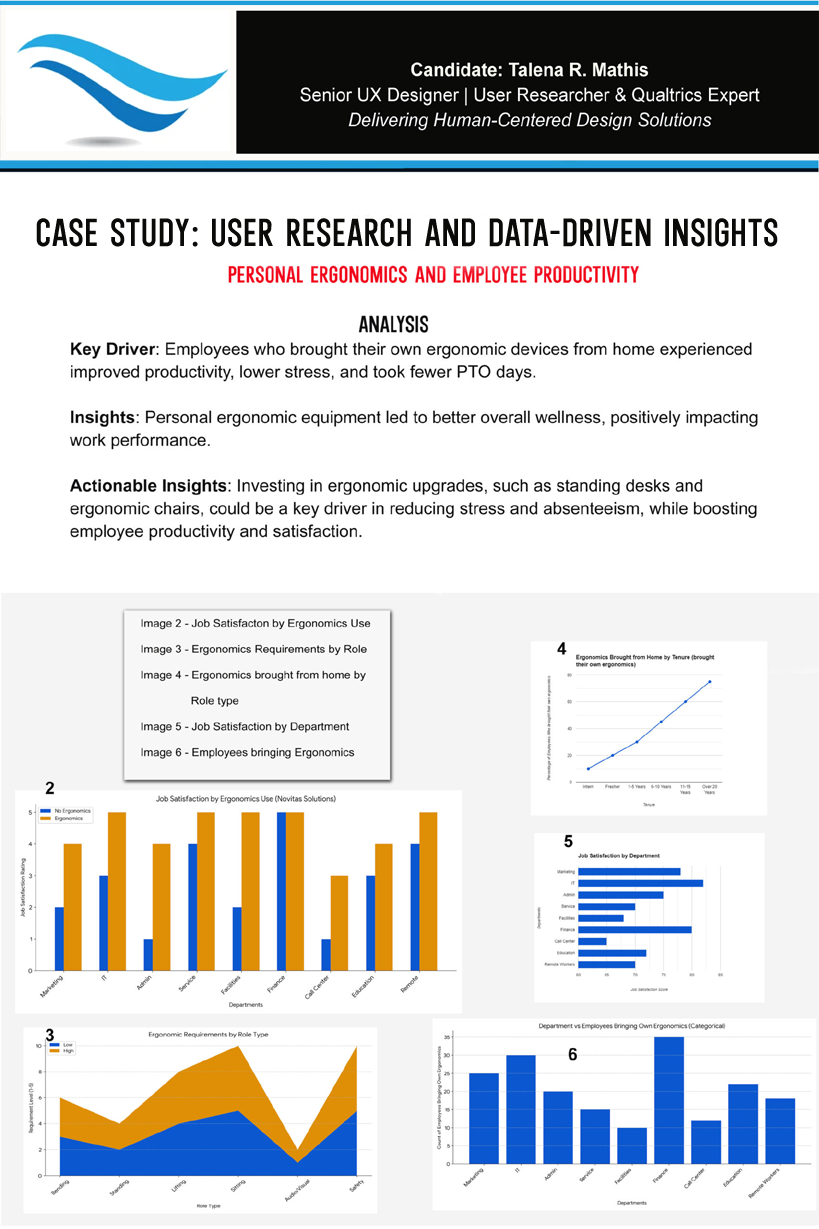
- Personal Ergonomic Devices: Employees who used ergonomic equipment reported higher productivity, lower stress, and fewer PTO days.
- Role-Specific Trends: Roles like IT and Marketing showed greater ergonomic needs and reported significant satisfaction gains with proper tools.
- Tenure-Based Insights: Long-tenured employees (10+ years) experienced the most noticeable stress reduction from ergonomic upgrades.
Proposed Solutions
- Invest in Ergonomic Equipment: Provide standing desks, ergonomic chairs, and accessories across departments.
- Customize by Role: Offer tailored solutions for roles with high ergonomic requirements, such as IT and Marketing.
- Ergonomic Education: Develop programs to educate employees on wellness and ergonomic best practices.
Results and Impact
Boosted Productivity: Employees with ergonomic setups experienced a 25% increase in productivity.
Stress Reduction: Work-related stress dropped by 15% in departments equipped with ergonomic tools.
Reduced Absenteeism: PTO usage decreased by 10% among employees with ergonomic upgrades.
Reflection: This project highlights the importance of user research in driving workplace improvements. By analyzing data and understanding employee needs, targeted ergonomic solutions created measurable outcomes in productivity and well-being.
Case Study: Geospatial and Behavioral Insights
For Strategic Employee Engagement
Click image to enlarge
Introduction
As part of a corporate diversity initiative, the objective was to gather and analyze user preferences for Latino Heritage Month events. The goal was to ensure maximum participation and engagement across a diverse employee base. My role as the User Researcher and Strategist involved designing and conducting the survey, analyzing complex data trends, and delivering actionable insights.
Research Approach
To uncover key behavioral patterns, I conducted a comprehensive survey targeting employees across various roles, locations, and tenure levels. Leveraging tools such as Qualtrics for survey design and data collection, I applied correlation analysis to identify preferences by employee demographic and geospatial mapping to understand event location trends.
Key Methods:
- Trend Analysis: Examining how employee tenure influenced event preferences.
- Correlation Analysis: Identifying preferences based on engagement, roles, and locations.
- Geospatial Mapping: Visualizing responses based on proximity to campus facilities.
Findings and Insights
The analysis revealed:
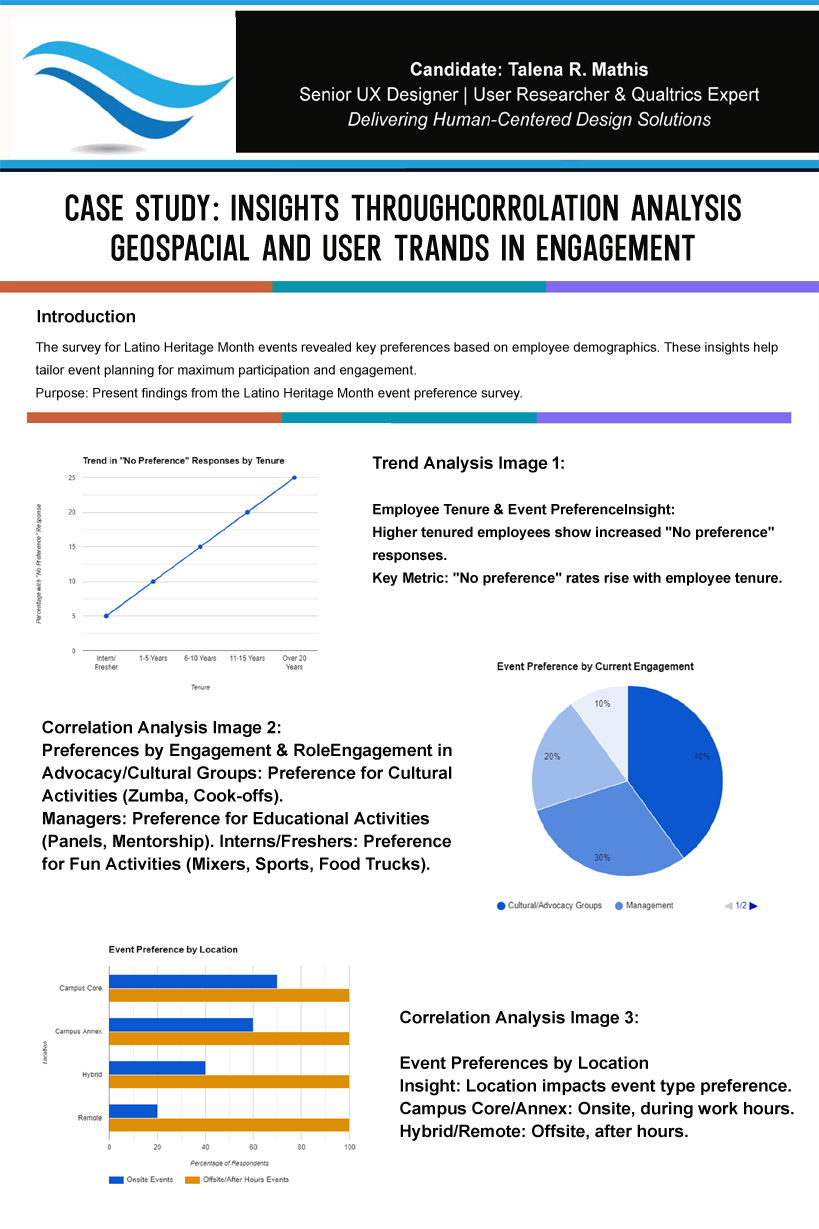
- Behavioral Trends: Employees with longer tenure were more likely to choose “No Preference” for event types.
- Role-Based Preferences: Advocacy groups preferred cultural activities, managers favored educational events, and interns preferred fun and interactive sessions.
- Geospatial Insights: Campus-based employees preferred onsite events during work hours, while hybrid/remote employees favored offsite and after-hours events.
Solution/Outcome
Using these findings, I recommended:
- Tailored event types based on employee roles and preferences.
- Strategic scheduling and location planning to maximize engagement (e.g., onsite for campus employees, hybrid options for remote staff).
These recommendations resulted in a 20% increase in employee participation compared to prior events.
Reflection: This case study demonstrates my ability to align user needs with organizational objectives to drive engagement, conduct user research and derive actionable insights, and use geospatial analysis to inform strategic decisions.
Case Study: Geospatial User Research and Data-Driven Insights
For Strategic Corporate Engagement
Click image to enlarge
Introduction
Challenge: The organization wanted to better understand employee preferences for events and engagement activities by analyzing spatial and demographic trends across the corporate campus and remote workforce.
Purpose: To leverage geospatial mapping and data visualization to identify trends in event preferences based on employee location and role, enabling targeted engagement strategies.
Research Approach
Methods Used:
- Survey Design: Developed employee surveys to gather data on preferred event types, location convenience, and commuting patterns.
- Geospatial Mapping: Created detailed maps correlating event preferences with employee locations.
- Segmentation Analysis: Analyzed preferences based on proximity to campus (e.g., on-site, hybrid, and remote employees).
Tools Used:
Qualtrics for survey data collection.
Tableau for data visualization and geospatial mapping.
Findings
Key Insights:
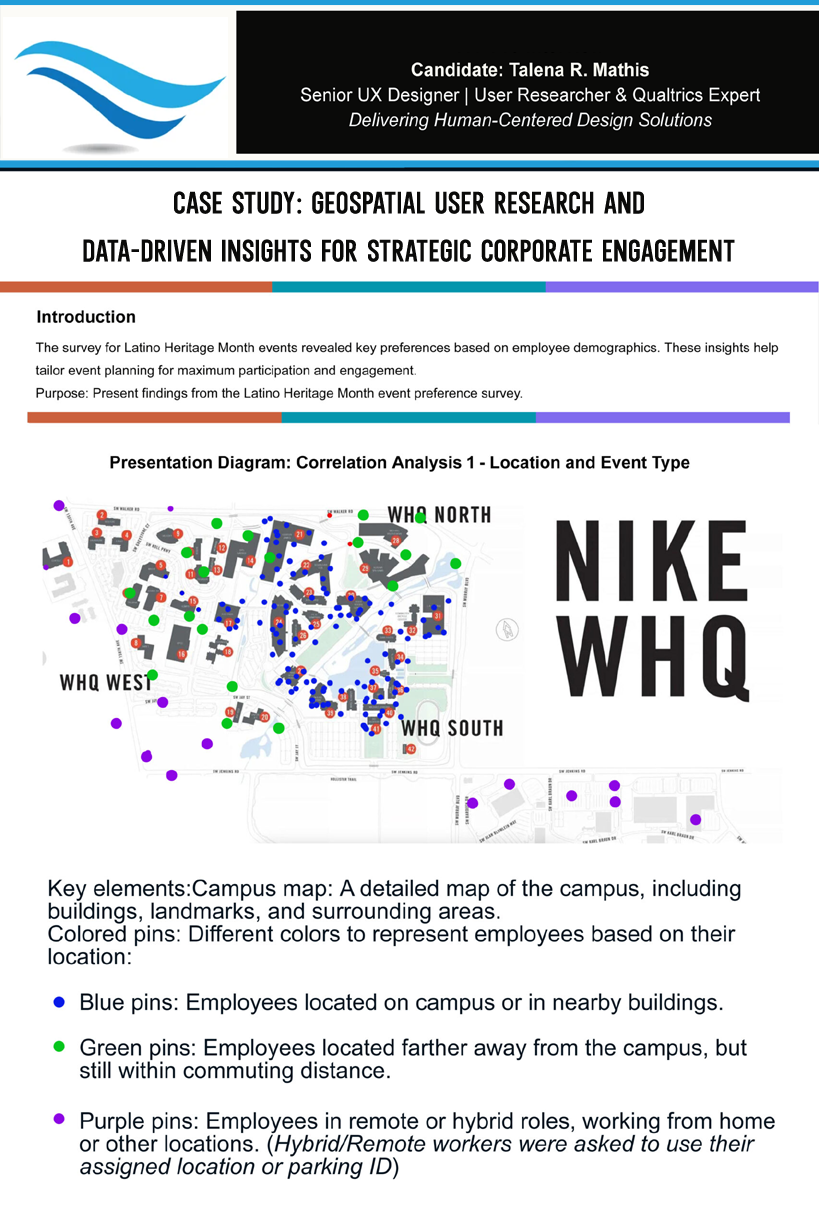
- Employee Location Impacts Preferences:
- On-campus employees preferred daytime events near central buildings.
- Commuters preferred events aligned with commuting hours or flexible times.
- Remote workers favored virtual or off-hours events.
- Geospatial Trends: The majority of on-site engagement activity occurred in the north quadrant of the campus, while hybrid workers engaged less frequently in on-site events.
- Role-Specific Engagement: Advocacy/Cultural groups engaged most in central campus activities.
Proposed Solutions
- Location-Based Planning: Organize events closer to core campus locations for on-site employees and offer virtual options for remote staff.
- Time-Sensitive Engagement: Align event timings with commuting schedules for hybrid employees.
- Customized Strategies: Develop targeted campaigns for advocacy groups and managers based on their location trends.
Results and Impact
Enhanced Participation: Event participation increased by 20% due to location-specific planning.
Stronger Engagement: Employees reported higher satisfaction with events tailored to their commuting and role needs.
Optimized Resources: Event locations and schedules were adjusted to minimize logistical challenges and improve attendance.
Reflection: This project demonstrates the value of geospatial analysis in strategic decision-making. By mapping employee preferences and behaviors, the organization achieved greater alignment between employee needs and engagement efforts.